
“NEW” EVIDENCE AND A SECOND APPLICATION DOES NOT GIVE RISE TO A SECOND CHANCE: ABUSE OF PROCESS LEADS TO STRIKE OUT
This is a case that shows the importance of putting your best case forward at the first opportunity. Litigants can never assume they will obtain a second chance. The judge held that a second (similar) application made to prevent a winding up petition was an abuse of process.
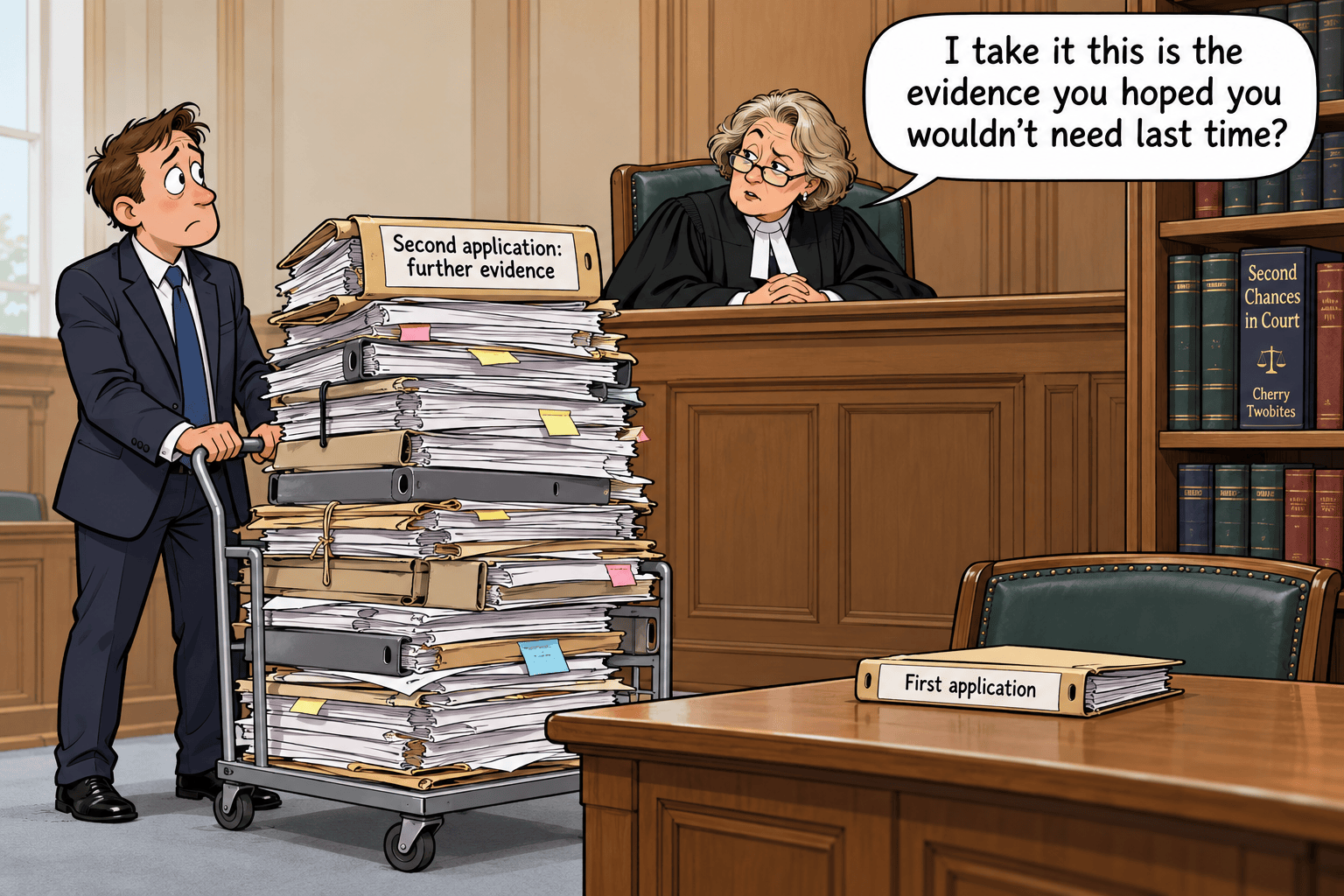
“The private interest of Elevate in seeking to reopen the case must be weighed against the position of Fine Star whose interests include finality after the hearing before the Judge on 13 July 2026 and not to incur further costs. In my judgment, the public interest in this case does not allow Elevate to seek effectively a reopening of the hearing before the Judge on 13 July 2026. The courts should not allow parties to be able to utilise the court’s time and resources to hear cases when there no justification on the evidence to allow that to occur. The exchange between the Judge and Counsel as to the evidence and the proposed adjournment sought in the event that the Judge was not satisfied on the evidence before him is also relevant. Elevate was hoping its evidence was sufficient to succeed but if not, it wanted to be able to run its case again on another date. The change of counsel before 13 July 2026 in my judgment, takes the matter no further. No adjournment was sought on that basis and what is sought now is a new hearing with the new evidence.”
KEY PRACTICE POINTS
Litigants must assume that they will only get one bite of the cherry. The decision is a reminder of the importance of putting the available evidence before the court at the first hearing—and of explaining any genuine difficulty in doing so at that hearing. A party that proceeds with an application and loses may find that assembling a fuller evidential case afterwards does not give it another opportunity to argue the same issues.
THE CASE
Elevate Estates Management Ltd v Fine Star Estates Ltd [2026] EWHC 2728 (BP) (23 October 2026) ICC Judge Agnello KC
THE FACTS
Fine Star had presented a winding up petition against Elevate in respect of rent arrears. The petition debt was £836,537.23.
Elevate applied to restrain advertisement of the petition and to have it dismissed. It argued that the debt was disputed on genuine and substantial grounds and that it had a substantial cross-claim against Fine Star.
The application was heard by Chief ICC Judge Briggs on 13 July 2026. He found that there was no genuine dispute as to the petition debt and that the cross-claim had not been substantiated. The application was dismissed.
Elevate subsequently sought permission to appeal. A temporary stay was granted, but an application to extend it was refused. At the time of ICC Judge Agnello KC’s judgment, the application for permission to appeal had not been determined.
THE SECOND APPLICATION
Elevate made a further application to dismiss the petition. It relied on a much more substantial body of evidence, including property-by-property reconciliations, documents said to support the cross-claim, and evidence of a further accounting claim.
It also offered to pay or secure approximately £89,000, which it accepted might be due.
Elevate’s position was that it had needed further time to gather and assemble its records. Its evidence included an account of its exclusion from its office premises shortly before the first hearing and the difficulties that this had caused in accessing equipment and records.
Fine Star applied to dismiss the second application as an abuse of process.
WHAT HAPPENED IN A NUTSHELL
The judge held that the second application was an abuse of process. It was struck out as an abuse of process.
WAS THE FIRST DECISION A FINAL DECISION?
A central issue was whether the hearing before Chief ICC Judge Briggs had been a final determination, or an interlocutory hearing whose outcome did not prevent the issue being considered again.
ICC Judge Agnello KC held that it had been a final hearing of the original application:
“It determined that the debt was not disputed on substantial grounds and that the cross claim had not been established. That is a final and binding decision of those issues as well as the final determination of the original application.”
The judge rejected the argument that the question of whether the debt was disputed on substantial grounds could simply be reconsidered at the hearing of the petition. The petition would proceed on the basis of the decision already made. If Elevate was unhappy with that decision, it could seek to appeal.
The judge also held that it made no material difference that the first application had sought an injunction restraining advertisement as well as dismissal of the petition, whereas the second sought dismissal.
THE DIFFERENT PRINCIPLES
The judgment considers several related principles: cause of action estoppel, issue estoppel, the rule in Henderson v Henderson, and the principles relating to repeated applications discussed in Harvey v Dunbar.
The judge held that cause of action estoppel applied. The second application sought to establish the same cause of action: that the petition was an abuse of process and should be dismissed. On that basis, she held that there was an absolute bar to the new application being heard.
Alternatively, she held that issue estoppel applied. The same issues—whether the debt was disputed on substantial grounds and whether there was a cross-claim—had already been determined. Elevate’s attempt to reopen them depended on showing special circumstances.
The judge also considered the Henderson v Henderson principles. She accepted that the court must take a broad, merits-based approach to whether the process has been abused. However, she rejected the submission that this required a “mini hearing” to assess the merits of the new evidence before deciding whether the case could be reopened.
As to the principles discussed in Harvey v Dunbar, the judge observed that finding a better way of putting the same point, or obtaining more evidence to support it, did not in itself justify arguing the point again.
WHY HAD THE EVIDENCE NOT BEEN PRODUCED?
The explanation for the missing evidence was examined closely.
The judge noted that Elevate’s witness statement of 9 July 2026 had not referred to the loss of access to the premises on 8 July. Nor had that alleged loss of access been raised with Chief ICC Judge Briggs at the hearing on 13 July.
There had been an invitation to adjourn part of the application if the judge considered the evidence insufficient. But the point advanced at that hearing related to difficulties accessing bank information; the alleged exclusion from the premises was not put forward as a reason for an adjournment.
There was also evidence before the first judge that Elevate had been excluded from its premises on 15 June 2026. ICC Judge Agnello KC observed that there was no documentary support for the later exclusion date now relied upon and no explanation of the earlier exclusion.
The judge concluded:
“The evidence relied upon does not support a change in circumstances, exceptional or special reasons.”
The change of counsel before the first hearing did not take matters further: no adjournment had been sought on that basis.
THE OFFER TO PAY PART OF THE DEBT
Elevate’s offer to pay or secure approximately £89,000 did not change the outcome. The first judge had held that there was no substantial dispute about the petition debt. An offer to pay a small part of that debt did not entitle Elevate to reopen the hearing and present its case again with additional evidence.
THE JUDGMENT
Discussion
General Applicable Legal Principles
- The new application stands to be dismissed as an abuse of process ( including res judicata ) if it falls under one of the below categories :-
(1) It constitutes a cause of action estoppel which is absolute. The bar is absolute in relation to all points decided unless fraud or collusion is alleged such as to justify setting aside the earlier judgement. The discovery of new factual matters which could not have been found out by reasonable diligence for use in the earlier proceedings does not, according to the law in England permit the later to be reopened. This was reiterated by Lord Sumption in Virgin who stated at paragraph 26, ‘Where the existence of non -existence of a cause of action has been decided in earlier proceedings, to allow a direct challenge to the outcome, even changed circumstances and with material not available before, offends the core policy against re-litigation of identical claims’.( paragraphs 22 and 26 – Virgin )
(2) It constitutes an issue estoppel. The bar is not absolute in that the existence of special circumstances where it would cause injustice will allow new points to be raised. If the new point was not raised, or further material relevant to the correct determination of a point had not been adduced, then the bar will usually be absolute if it could with reasonable diligence and should in all the circumstances have been raised or the material been adduced in the earlier proceedings. ( paragraphs 21 and 22 – Virgin )
(3) It constitutes an abuse of process under the Henderson v Henderson principles. The court requires the parties to ligation to bring forward their whole case and will not except under special circumstances permit the same parties to open the same subject of litigation in respect of the matter which might have been brought forward as part of the subject in contest but which was not brought forward only because they have, from negligence, inadvertence, or even accident, omitted part of their case. ( paragraphs 19 and 24 of Virgin).
(4) The new action is an abuse under the Turner principles as set out in Harvey v Dunbar, that (1) it is a waste of court’s time and the parties money to rehearse arguments which have already been run and have failed and (ii) in circumstances where the debtor wishes to run new arguments, the court will inquire why those arguments were not run at the time when they could and should have been run. The court determines that the evidence did not demonstrate a change of circumstance or special or good reason. [ paragraphs 40, 44, 48].
A. Cause of action estoppel
51. The characterisation of the cause of action has been challenged as being an interlocutory one such that it is incapable of falling under a cause of action estoppel. It is argued that the findings made on 13 July 2026 were based on limited evidence and do not create a judgment or relief which Fine Star can rely upon to establish an undisputed debt at the petition hearing itself.
52. There is no dispute that the original and new application concern the same parties. The original application was made on the grounds that the debt claimed in the petition was disputed on genuine and substantial grounds and that on the evidence there was a cross claim which equalled or exceeded the petition debt. It is an abuse to present and or prosecute a petition if the debt is disputed on substantial grounds. A cross claim which equals or exceeds the petition is treated as being effectively a disputed debt. These are well known principles which were admitted by Mr McCarthy who relied upon the well known cases of Re Bayoil SA [1999] 1 WLR 147 and Angel Group Ltd v British Gas Trading Ltd [2012] EWHC 2702 ( Ch). The new application seeks a dismissal of the petition on the same grounds as the original application.
53. In my judgment, the cause of action is seeking a permanent and final injunction restraining the presentation of the winding up petition and a dismissal of the petition on the grounds that the debt is disputed (including the existence of a cross claim). This is because there is no basis upon which the petition could be presented or prosecuted if the debt is disputed. If the injunction restraining advertisement is granted, then in my judgment, this will lead to the dismissal of the petition on the grounds that the debt is disputed.
54. Interlocutory orders can be made and frequently are made by the court prior to the final hearing of the application. These restrain advertisement of the petition until the next hearing date or effective hearing of the application. The orders made prior to the final hearing of the application are interlocutory.
55. In my judgment, the proceedings before Chief ICC Judge Briggs was a final hearing of the original application. It determined that the debt was not disputed on substantial grounds and that the cross claim had not been established. That is a final and binding decision of those issues as well as the final determination of the original application. Contrary to Elevate’s submission, the issue of whether the debt was disputed on substantial grounds does not fall to be reconsidered at the petition hearing itself. The petition proceeds on the basis that there is an undisputed debt. The determination by the insolvency court is whether the debt is disputed on substantial grounds. That is the issue. If that is established, then the petition cannot proceed. Conversely, if the evidence does not establish that the debt is disputed on substantial grounds, then the petition will proceed. If a party is unhappy with the decision, it can seek to appeal.
56. It is immaterial that the original application sought an injunction restraining advertisement as well as dismissal and the new application sought merely the dismissal of the petition. In my judgment, it remains the same cause of action. The cause of action is identical, being to establish that the petition is an abuse of process and stands to be dismissed.
57. In my judgment, the case of Woodhouse provides no support to the Applicant. There are fundamental distinctions to be drawn between summary judgment proceedings and the original and new application proceedings. Unlike summary judgement proceedings, there are no underlying court proceedings which would lead to a trial if the summary judgment proceedings are unsuccessful. The original and new application are not capable of being characterised as being pre-trial proceedings. Winding up proceedings are only available when the debt is not disputed. There is no trial of the disputed debt or the asserted cross claim. The challenge to the debt being disputed is in many respects a challenge as to the jurisdiction to present and prosecute a winding up petition. Conversely, in summary judgment proceedings, there are court proceedings which lead to a trial unless the summary judgment succeeds.
58. In my judgment, Woodhouse provides no support relating to the characterisation of the original application and the new application. Woodhouse relates to pretrial applications expressly held by the Court of the Appeal to be interlocutory. The statutory regime in Woodhouse is substantially different from the one in the current case.
59. Mr McCarthy also relied upon Harvey v Dunbar in support of his submission that cause of action estoppel and issue estoppel did not apply in this case because the current case were insolvency proceedings. In my judgment, both cause of action estoppel and issue estoppel are capable of being applied in the current case. In Harvey v Dunbar, at paragraph 47, the Court of Appeal explained why neither of those principles applied. The decision below had been set aside by the appellate court and therefore it was not capable of constituting either a cause of action estoppel or an issue estoppel. That is not the position here. The decision of chief ICC Judge Briggs has not been set aside and remains final and binding.
60. In my judgment, cause of action estoppel applies for the reasons set out above. The effect of the cause of action estoppel is that Elevate is prevented from pursuing the new application seeking dismissal of the petition. This is as set out in Virgin, an absolute bar to the new application being heard.
B. Issue estoppel
61. Alternatively, in my judgment, the new application constitutes an issue estoppel. The issue of whether the debt is disputed in substantial grounds and the raising of the cross claim are identical in relation to the original and new application. This issue was determined by the court on 13 July 2026. Elevate seeks to rely on new evidence to re open the issue. Whether Elevate is entitled to re-open the issue and re argue it based on the new evidence depends upon the existence of special circumstances relied upon by Elevate.
62. Neither party submitted that the tests of special circumstances in relation to issue estoppel, Henderson v Henderson or the Turner principles are different. The wording used in the cases refer to special circumstances, exceptional circumstances, and/or special reasons. Although this point was not argued before me, I will approach these tests as being essentially the same in that I will deal with the evaluation of the evidence relied upon by Elevate and the factual circumstances including what occurred before the Judge on 13 July 2026 after consideration of both Henderson v Henderson and the Turner principles. The public interest in not being able to pursue duplicative proceedings is relevant regardless as to whether the issue is one of issue estoppel, Henderson v Henderson or the Turner principles.
C. Henderson v Henderson
63. The principles in Henderson v Henderson apply where a point or issue which could have been raised at the hearing was not raised. In this case, Elevate seeks to rely on new evidence and to re-open the issue of whether the debt is disputed on grounds which are substantial and the existence of the cross claim. These issues were before the Court on 13 July 2026 and were determined. In my judgement, the principles of Henderson v Henderson apply.
64. Mr McCarthy relied on the approach to Henderson v Henderson set out by Lord Bingham in Johnson v Gore Wood. The test to be applied in relation to Henderson v Henderson is not to be applied simply by asking whether the matter or evidence could have been raised at the earlier hearing as to render the raising of it at a later hearing abusive. Instead, as stated by Lord Bingham in Johnson v Gore Wood ( page 31), the court takes a broad, merits based judgment which takes into account of the public and private interests involved and also takes into account the facts of the case, focusing attention on the crucial question whether, in all the circumstances, a party is misusing or abusing the process of the court by seeking to raise before it the issue which could have been raised before. In my judgment, this does not mean that the court engages in carrying out some form of mini hearing by considering the new evidence and its merits as part of that exercise. In my judgment, the court focuses on the facts of the case and in particular the conduct of the party. The approach is to consider whether in all the circumstances the party’s conduct is an abuse.
65. I reject Mr McCarthy’s argument that the court needs to consider and assess the new evidence in determining whether there are special circumstances to enable the case to be re-opened. That is not what is set out in Johnson v Gore Wood. In my judgment, Mr McCarthy’s approach would lead to a re- opening of the issue which is exactly what the party is not entitled to seek without the Court being satisfied that such a reopening is not an abuse. I have read the new evidence and it seeks effectively to invite the court to consider the new evidence supporting the disputed debt assertion by the production of numerous documents and material which was not before the Court on 13 July 2026. There are also additional witness statements seeking also to support the existence of the asserted disputed debt and cross claim.
(D)The Turner principles – Harvey v Dunbar
- In my judgment, the Turner principles are equally applicable here. Paragraph 41 of the judgment in Harvey v Dunbar expressly confirms that, ‘…it requires exceptional circumstances before he can raise the same argument at a later stage during the same process. Neuberger J went on to say that the principle should not be abrogated simply because the party has found a better way of putting the same point, or wants to put in more evidence to support the same point.’
- In my judgment, this applies with equal force in the case before me. Elevate is seeking to put in more evidence to support the same point. The issue is whether there are special or exceptional circumstances to justify the re-opening or re-arguing the issue.
Change of Circumstances – special reason – party’s conduct
- Mr McCarthy relied on Woodhouse as authority for the proposition that the court should approach the test of change of circumstances and/or special reason in a less strict way. In my judgment, that less strict approach set out in paragraph 56 related to the types of pre trial applications which were before the Court of Appeal. Paragraph 57 provided as an example a rather extreme case relating to an application for summary judgment where the new evidence made it unanswerable on the merits. Mr McCarthy did not suggest that the new evidence fell into that type of category. A reading of that evidence makes it clear, in my judgment, that it is not the type of evidence which equates to the extreme example given at paragraph 57 of Woodhouse. I reject the approach here to be one of a less strict approach.
- In his fifth witness statement dated 3 August 2026, Mr Brown stated that Elevate relied on the completed reconciliations, the supporting evidence for its cross claim and evidence obtained since the last hearing on 13 July 2026 on the grounds that the Company had had additional time to gather its documents and evidence. This witness statement is silent in relation to why that evidence had not been before the court on 13 July 2026. Mr Brown then filed a further witness statement, his seventh, dated 10 August 2026 which explains that on 8 July 2026, the company has been excluded from its premises. This is the reason provided by Mr Brown as to why the evidence the company now seeks to rely upon was not before the court on 13 July 2026.
- The earlier witness statement of Mr Brown dated 9 July 2026 which was filed shortly before the hearing on 13 July 2026 is completely silent in relation to what Mr Brown set out in his witness statement dated 10 August 2026. The arguments relating to lack of access and needing further time to obtain further evidence were not raised before the Judge on 13 July 2026. I have considered carefully the transcript and the exchanges as between Counsel and the Judge. There was no reference to the exclusion from the premises on 8 July 2026. Additionally, as pointed out by Mr Patterson, the evidence before the Judge on 13 July 2026 demonstrated that Elevate was excluded from its premises on 15 June 2026, being well before the hearing on 13 July 2026. There is no documentary support relating to the loss of premises on 8 July 2026 now relied upon by Mr Brown.
- Even if the exclusion was on 8 July 2026, there is no explanation relating to the earlier exclusion on 15 June 2026. Additionally, the conduct of Elevate is of concern. The witness statement dated 9 July 2026, being a reply to the evidence filed in opposition by Fine Star, denies that the documentation produced by Elevate was insufficient to support its dispute and cross claim. This demonstrates that Elevate was well aware of the evidence it was relying upon and the risk that it was insufficient for its purposes. This makes a failure to deal with the lack of access to the premises now relied upon even more surprising.
- Elevate issued the original application on 30 June 2026. Accordingly Elevate had access to all the documentation it needed to present its case at that stage. It elected to present its case in the witness statement filed in support of its application without the detailed material it now seeks to rely upon. On its own case, the exclusion only occurred on 8 July 2026.
- In my judgment, the conduct of Elevate constitutes an abuse as defined in the cases above. The evidence relied upon does not support a change in circumstances, exceptional or special reasons. There is a failure to raise the issue of exclusion now relied upon both in the witness statement of 9 July 2026 and before the Judge on 13 July 2026. The exclusion did not form part of the application to adjourn which was made on 13 July 2026. There is the contradictory evidence relating to the evidence of the earlier exclusion.
- The private interest of Elevate in seeking to reopen the case must be weighed against the position of Fine Star whose interests include finality after the hearing before the Judge on 13 July 2026 and not to incur further costs. In my judgment, the public interest in this case does not allow Elevate to seek effectively a reopening of the hearing before the Judge on 13 July 2026. The courts should not allow parties to be able to utilise the court’s time and resources to hear cases when there no justification on the evidence to allow that to occur. The exchange between the Judge and Counsel as to the evidence and the proposed adjournment sought in the event that the Judge was not satisfied on the evidence before him is also relevant. Elevate was hoping its evidence was sufficient to succeed but if not, it wanted to be able to run its case again on another date. The change of counsel before 13 July 2026 in my judgment, takes the matter no further. No adjournment was sought on that basis and what is sought now is a new hearing with the new evidence.
- In my judgment, the offer to secure or pay what Elevate now concedes may be an undisputed part of the petition debt in the sum of approximately £89,000 does not assist. It cannot constitute a change of circumstances so as to enable Elevate to reopen the hearing before the Judge on 13 July 2026. The offer to pay does not cover the entirety of the petition debt. The Judge held that there was no dispute. An offer to pay a small part of the petition debt does not entitle Elevate to reopen the hearing and present its case with all its new evidence.
- For the reasons set out above, I dismissed the new application.
RELATED POSTS
| Post | Date | Brief summary |
|---|---|---|
| Can you have an interim injunction when you have been refused identical relief in the past? Claimants not allowed a second bite of the cherry | 1 September 2026 | Following the dismissal of an injunction application, the claimants issued proceedings and sought an injunction in identical terms. The second attempt was not permitted; the principles preventing repeated attempts apply to interlocutory applications. Civil Litigation Brief ® |
| The court was wrong not to strike the defence out: a failure to dispute a point in the Jersey courts meant it was not open to a defendant to argue it in a second action | 2 July 2026 | On appeal, the court held that a point which could have been disputed in earlier Jersey proceedings could not be pursued in the later action. Civil Litigation Brief ® |
| The defendant’s acceptance of a Part 36 offer from the claimant did not prevent a second action in relation to a different (but related) issue | 14 May 2026 | The Court of Appeal allowed an appeal in part. Part of the second action was not an abuse: it concerned an issue that had not been pleaded when the defendant accepted the earlier Part 36 offer. Civil Litigation Brief ® |
| The defendants’ application was an abuse of process: the dangers of trying similar things a second time around | 5 March 2026 | The defendants made an application for reverse summary judgment or strike-out after a similar application much earlier in the litigation. The post considers the application of the Henderson and Hunter principles to interlocutory hearings. Civil Litigation Brief ® |
| A Part 36 offer cannot be outside the scope of the pleadings: nor can the offeror argue that it was not, in fact, a Part 36 offer at all | 3 March 2026 | The defendant argued that a second action was an abuse because an earlier action had settled through acceptance of a Part 36 offer. The claim in the second action had, however, been specifically excluded from the first. Civil Litigation Brief ® |
| Asking the judge to determine issues of ownership was not an abuse of process: the same argument ran twice | 13 January 2026 | The judge rejected an argument that it was abusive to raise ownership issues related to another, stayed action between the parties. Determining the question was central to the court’s role in the trial. Civil Litigation Brief ® |
| Was this “second” action an attempt to re-open matters that had been determined in an earlier hearing? | 12 January 2026 | The post considers the difficulty facing a party seeking to bring a second action to set aside an earlier judgment on the basis that it was obtained by fraud. Civil Litigation Brief ® |
| Second—and third—applications for relief that are, essentially, for the same thing not allowed to proceed: the applications were abusive | 1 July 2025 | Defendants who had been debarred from defending made successive applications to vary the relevant orders and obtain relief from sanctions. The later applications were held to be abusive. Civil Litigation Brief ® |
| Second action struck out as an abuse of process: hiding an intention to start fresh proceedings is a highly dangerous strategy | 29 November 2024 | In BCLI v Commissioner of Police for the Metropolis, the second action was struck out as an abuse on its facts. The post highlights the danger of concealing an intention to commence fresh proceedings. Civil Litigation Brief ® |
| Personal injury action brought after Employment Tribunal settlement not an abuse of process: the defendant has got what it signed up to | 1 September 2021 | A personal injury action following the settlement of Employment Tribunal proceedings was not an abuse of process. The terms of the settlement were material to the result. Civil Litigation Brief ® |
| A second—identical—application was an abuse of process and dismissed on that ground alone | 10 July 2019 | In Lambert v Forest of Dean District Council, ICC Judge Mullen dismissed an application as abusive where an identical earlier application had already been struck out. Civil Litigation Brief ® |
| Second action struck out as an abuse of process: Court of Appeal decision | 28 March 2019 | In Harbour Castle Ltd v David Wilson Homes Ltd, the Court of Appeal considered the factors governing whether a second action is abusive. The second action was struck out. Civil Litigation Brief ® |
| Striking out a second action: different claimant but essentially the same action | 17 December 2018 | In Samuel v Samuel, Master Teverson struck out a later action following similar earlier proceedings that had been compromised. The later action was brought by a different claimant. Civil Litigation Brief ® |
| Second action not struck out as an abuse of process: claim in deceit can continue after claim in negligence failed | 12 September 2018 | In Playboy Club London Ltd v Banca Nazionale del Lavoro, the Court of Appeal allowed a subsequent deceit claim to proceed after a negligence claim had failed. The claimant had not been obliged to gamble on a fraud claim in the first proceedings. Civil Litigation Brief ® |
| Service at the last known address, CPR 6.15 and is the issue of a “second action” an abuse of process? | 3 September 2018 | Sajid v Nuur considers service at a last known address and the position where a second claim form is issued following difficulties with the first. Civil Litigation Brief ® |
| Second action not an abuse of process: court resources do not “trump the overriding need to do justice” | 10 December 2017 | In Davies v Carillion Energy Services Ltd, Mr Justice Morris upheld the decision that a second claim was not abusive. The case is a useful counterpoint to decisions striking out repeat proceedings. Civil Litigation Brief ® |
| Second application for security for costs was not an abuse of process—this time | 29 November 2016 | In Holyoake v Candy, Mr Justice Nugee permitted a second security application. The judgment examines when matters can be reopened, including where relevant facts were not reasonably discoverable for the first hearing. Civil Litigation Brief ® |
| Two procedural points: a second action is not always an abuse of process & a bankrupt cannot bring proceedings | 28 September 2016 | Khan v Khan provides a reminder that a second set of proceedings is potentially abusive, but that issuing it does not automatically make it so. Civil Litigation Brief ® |
| Second action struck out as an abuse of process: report of first-instance decision | 3 January 2014 | An early post on the consequences of starting fresh proceedings after an earlier claim has been struck out and relief from sanctions has been refused. |


You must be logged in to post a comment.