
WITNESS EVIDENCE WEDNESDAY: WHERE ARE WE NOW ON “MISSING” WITNESSES AND EVIDENCE ? TEN KEY POINTS WITH USEFUL LINKS
Much of litigation is taken up with the contents of witness statements and their veracity, or otherwise. However there is an important element in relation to missing evidence and “missing” witnesses. What inferences should the court draw if a party submits that a key witness for their opponent is missing? This question was raised in a recent judgment and provides an opportunity for a review of the situation.
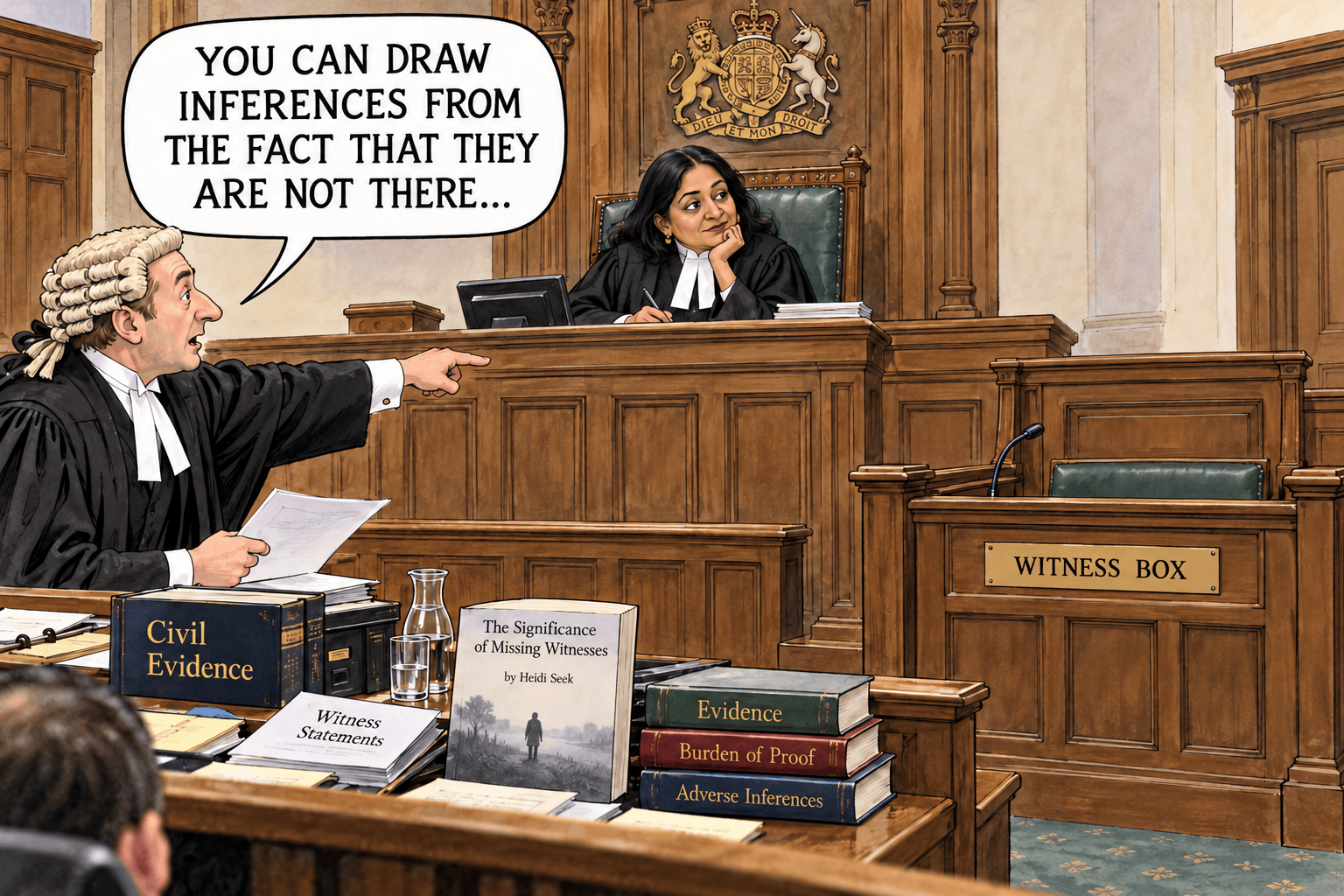
“So far as possible, tribunals should be free to draw, or to decline to draw, inferences from the facts of the case before them using their common sense without the need to consult law books when doing so. Whether any positive significance should be attached to the fact that a person has not given evidence depends entirely on the context and par ticular circumstances”
KEY PRACTICE POINTS
Every litigator needs a working knowledge of the likely consequences if a witness statement is not obtained or a witness not called. This can have major consquences for your own case, or your assessment of your opponent’s case.
THE RECENT JUDGMENT IN BEGG -v- WOOD
Begg v Wood & Ors [2026] EWHC 2622 (BP) (14 October 2026) HHJ Richard Williams, sitting as a Judge of the High Court.
THE JUDGMENT ON MISSING EVIDENCE AND MISSING WITNESSES
“34. The court may draw adverse inferences from the failure of a party (i) to produce contemporaneous documents that would have otherwise existed, if that party’s oral evidence is correct, and/or (ii) to call as a witness at trial a person who might be expected to give important evidence.
Absence of contemporaneous documentary evidence
35. In Re: Mumtaz Properties Ltd [2011] EWCA Civ 610, Arden LJ said:
“[14] In my judgment, contemporaneous written documentation is of the very greatest importance in assessing credibility. Moreover, it can be significant not only where it is present and the oral evidence can then be checked against it. It can also be significant if written documentation is absent. For instance, if the judge is satisfied that certain contemporaneous documentation is likely to have existed were the oral evidence correct, and that the party adducing oral evidence is responsible for its non-production, then the documentation may be conspicuous by its absence and the judge may be able to draw inferences from its absence.”
Failure to call a witness of fact to give evidence
36. In Royal Mail Group Ltd (Respondent) v Efobi (Appellant) [2021] UKSC 33, Lord Leggatt said:
“[41.] The question whether an adverse inference may be drawn from the absence of a witness is sometimes treated as a matter governed by legal criteria, for which the decision of the Court of Appeal in Wisniewski v Central Manchester Health Authority….is often cited as authority. Without intending to disparage the sensible statements made in that case, I think there is a risk of making overly legal and technical what really is or ought to be just a matter of ordinary rationality. So far as possible, tribunals should be free to draw, or to decline to draw, inferences from the facts of the case before them using their common sense without the need to consult law books when doing so. Whether any positive significance should be attached to the fact that a person has not given evidence depends entirely on the context and particular circumstances. Relevant considerations will naturally include such matters as whether the witness was available to give evidence, what relevant evidence it is reasonable to expect that the witness would have been able to give, what other relevant evidence there was bearing on the point(s) on which the witness could potentially have given relevant evidence, and the significance of those points in the context of the case as a whole. All these matters are inter-related and how these and any other relevant considerations should be assessed cannot be encapsulated in a set of legal rules.”
Overall approach
- In making my findings of disputed facts in this case, I have had particular regard to the contents of the reliable contemporaneous documents, the undisputed facts including what the parties subsequently said and did, the objective inferences properly to be drawn from those undisputed facts and any missing evidence, and the overall probabilities including by reference to the parties’ motives.”
TEN KEY POINTS ON MISSING WITNESSES
1. START WITH COMMON SENSE: THIS IS NOT AN EXERCISE IN APPLYING A RIGID CHECKLIST
In Efobi, at paragraph 41, Lord Leggatt warned against making the question of absent witnesses overly legal and technical. The court must consider the circumstances of the particular case.
The Wisniewski principles remain useful guidance. However, they should not become a substitute for explaining why the absence of a particular witness supports a particular inference. Reciting the authorities is only the beginning of the argument.
Relevant post:
Missing witnesses: the Supreme Court says it is really a matter of common sense — 26 September 2021. Discusses the Supreme Court’s approach in Efobi.
2. AN ADVERSE INFERENCE IS PERMITTED: IT IS NOT COMPULSORY
There is an important difference between saying that a court may draw an adverse inference and saying that it must do so.
In Manzi v King’s College Hospital NHS Foundation Trust [2018] EWCA Civ 1882, the Court of Appeal considered the trial judge’s approach to an absent witness. The decision illustrates the evaluative nature of the exercise. Identifying someone who has not been called does not, by itself, establish an error in the judge’s findings.
Relevant post:
Drawing adverse inferences when witnesses are absent: Court of Appeal decision: court has a discretion as to the inferences to be drawn — 29 August 2018.
3. IDENTIFY WHAT THE WITNESS COULD ACTUALLY HAVE ADDED
An argument about a missing witness should identify the issue on which that witness could reasonably have been expected to give material evidence.
Was the witness present? Did they make the decision in question? Do they have first-hand knowledge? Would their evidence add anything to the documents and witnesses already before the court?
These questions matter more than the length of the list of people who have not been called. In Efobi, the Supreme Court expressly identified the evidence the witness could reasonably have given, and the significance of the relevant issues, as matters to consider.
Relevant post:
Civil evidence: absent doctor does not lead to an adverse inference — 13 May 2016. Discusses the first-instance decision in Manzi and whether an absent doctor justified an adverse inference.
4. AN ABSENT WITNESS DOES NOT REMOVE THE NEED FOR A CASE TO ANSWER
The Wisniewski guidance recognises that an adverse inference may strengthen one party’s evidence or weaken the other’s. It also identifies the need for some evidence on the relevant issue before the proposed inference can be drawn.
The practical lesson is straightforward: identify the evidence supporting the allegation before relying on the opponent’s silence. A missing witness is not a means of supplying every element of a case for which there is otherwise no evidential foundation.
Relevant post:
Proving Things 43: how the court decides: a primer — 7 December 2016. Discusses Adepoju v Akinola [2016] EWHC 3160 (Ch), the burden of proof and the potential effect of failing to call relevant evidence.
5. EXPLAIN THE ABSENCE: DO NOT LEAVE THE COURT TO GUESS
The reason why a witness has not been called can be decisive. A satisfactory explanation may prevent an adverse inference; a credible but incomplete explanation may reduce its force.
A useful illustration is Mantey v Ministry of Defence [2023] EWHC 761 (KB). At paragraphs 82–85, the judge considered the absence of the claimant’s neighbour. The solicitor explained in a witness statement that she had misunderstood an order as restricting the witnesses who could be called. The judge accepted that explanation and declined to infer that the neighbour would have failed to support the claimant.
That did not supply the missing evidence. It explained why the court should not speculate adversely about what the neighbour would have said.
Relevant post:
Adverse inferences not drawn when witnesses are absent: another example — 21 December 2016. Discusses the Wisniewski guidance, including the importance of an explanation for absence.
6. CONSIDER THE OTHER EVIDENCE BEFORE ASKING THE COURT TO DRAW AN INFERENCE
A witness’s absence must be assessed against the evidence that is available. Contemporaneous documents, admissions and other first-hand accounts may already address the relevant issue.
Conversely, where the absent person is the only participant capable of explaining a significant transaction, their silence may carry considerable weight.
In The Lord Chancellor v Blavo & Co Solicitors Ltd [2018] EWHC 3556 (QB), the court drew adverse inferences where key participants did not give evidence. The importance of the missing witnesses arose from their connection with the matters requiring explanation.
Relevant post:
Adverse inferences drawn when solicitor did not give evidence: if you’ve had £22 million you need to explain it — 2 January 2019. Expressly discusses the application of Wisniewski.
7. THERE IS NO GENERAL REQUIREMENT TO CALL EVERY POTENTIAL WITNESS
Litigators must select the evidence necessary to address the issues. The existence of another employee, participant or observer does not automatically require that person to be called.
In Astex Therapeutics Ltd v AstraZeneca AB [2017] EWHC 1442 (Ch), the court robustly rejected an argument based on absent witnesses. The decision is a useful reminder to examine whether there is a proper evidential reason for expecting the witness to attend.
Relevant post:
Absent witnesses do not lead to adverse inferences: argument would lead to new “costs and terror” in litigation — 21 June 2017.
8. DO NOT ASSUME YOUR OPPONENT WILL IDENTIFY THE GAPS IN YOUR EVIDENCE
The preparation of a case should include a review of which allegations require first-hand evidence and who can provide it.
It is dangerous to assume that an opponent will flag every omission before relying upon it. Equally, the proposed inference must remain connected to the issues properly before the court.
Relevant posts:
It’s not your opponent’s job to point out omissions in your own evidence: a closer look at one aspect of PJSC Tatneft — 30 November 2020.
Witness Evidence Wednesday: court would not draw adverse inferences from witnesses who were not called to give evidence — 4 February 2026. The court rejected an attempt to use absent witnesses to support a fishing exercise for an unpleaded case.
9. A SERVED WITNESS STATEMENT DOES NOT RESOLVE THE CONSEQUENCES OF NON-ATTENDANCE
If a witness who has provided a statement will not attend trial, address the position expressly. Consider the proposed use of the statement, the applicable evidential requirements and the explanation for the witness’s absence.
Particular difficulties can arise where parts of a statement have already been put to another witness in cross-examination. The court may then have to determine the status and permissible use of that material.
Relevant posts:
“Missing witnesses”—the inferences to be drawn: the use of your opponent’s witness statements—it’s all or nothing — 5 March 2018. Discusses Property Alliance Group Ltd v Royal Bank of Scotland plc [2018] EWCA Civ 355.
10. LOOK FOR MISSING DOCUMENTS AS WELL AS MISSING WITNESSES
An evidential gap may concern documents that should have existed, rather than someone who should have attended.
The practical questions include what records were created, what preservation steps were taken, why material is unavailable and who was responsible for its loss. Distinguish an absence of records from evidence of deliberate destruction: the circumstances may support very different conclusions.
Relevant posts:
“Missing” WhatsApp posts and a phone lost at sea: what inferences would the court draw? — 3 August 2022. Considers the missing electronic evidence in Vardy v Rooney.
Proving Things 299: disclosure failures, missing documents and the reliability of witness evidence: the consequences at trial — 12 October 2026. Examines the consequences of failing to preserve, or destroying, documentary evidence.
RELATED POSTS
| Post | Date | Brief summary |
|---|---|---|
| Proving Things 299: disclosure failures, missing documents and the reliability of witness evidence: the consequences at trial | 12 October 2026 | Examines the evidential consequences of failing to preserve, or deliberately destroying, documents. The judge regarded the first defendant’s conduct concerning documentary evidence as particularly telling. Civil Litigation Brief ® |
| Proving Things 293: the claimant establishes causation in a clinical negligence case: the judge did not draw adverse inferences—and this was a submission that put the defendant in some jeopardy… | 29 June 2026 | Considers the rejection of an invitation to draw adverse inferences because the claimant was not called to give evidence. A useful example of why an absent witness does not automatically justify an adverse inference. Civil Litigation Brief ® |
| Witness Evidence Wednesday: court would not draw adverse inferences from witnesses who were not called to give evidence | 4 February 2026 | The court rejected an argument based on the claimant’s failure to call witnesses. Cross-examination could not be used to fish for material supporting an unpleaded case inconsistent with the defendants’ pleaded position. Civil Litigation Brief ® |
| Another case where a witness statement was served but the witness did not attend trial: the defendant had used parts of the statement in cross-examination—what was its status? | 26 August 2025 | Considers the status of a statement where its maker did not attend and parts had already been put to another witness. The court was only informed of the non-attendance at the end of the trial. Civil Litigation Brief ® |
| Absent witnesses and adverse inferences (again): we don’t want to pay you the US$1,911,877,385 you are claiming: but we won’t give evidence | 11 August 2025 | Examines the consequences of defendants calling no factual evidence at all. The judge expressed clear views about why evidence had not been called. Civil Litigation Brief ® |
| Clinical Negligence Corner 3: absent doctors and adverse inferences—something to consider for all litigators here… | 11 August 2025 | Considers whether an adverse inference should be drawn from the failure to call a relevant expert. Related reading on the conclusions a court may draw when a potentially important witness is absent. Civil Litigation Brief ® |
| “Missing” WhatsApp posts and a phone lost at sea: what inferences would the court draw? | 3 August 2022 | Examines Vardy v Rooney [2022] EWHC 2017 (QB), concentrating on missing WhatsApp messages and the mobile phone said to have been lost at sea. Directly relevant to missing electronic evidence. Civil Litigation Brief ® |
| When WeChat messages are lost or destroyed—by a two-year-old: the adverse inferences a court can draw | 16 February 2022 | In ED & F Man Capital Markets Ltd v Come Harvest Holdings Ltd [2022] EWHC 229 (Comm), the judge concluded that messages had been deliberately lost and that adverse inferences could properly be drawn. Civil Litigation Brief ® |
| Missing witnesses: the Supreme Court says it is really a matter of common sense | 26 September 2021 | Directly discusses Royal Mail Group Ltd v Efobi [2021] UKSC 33. Explains the Supreme Court’s approach to absent witnesses as a matter of common sense and context rather than rigid legal rules. Civil Litigation Brief ® |
| Civil evidence: missing witnesses, Hamlet: “The rest is silence…”: oh, and it is the judge that is on trial | 30 August 2021 | Discusses witness evidence and missing witnesses in Ahuja Investments Ltd v Victorygame Ltd [2021] EWHC 2382 (Ch), arising from the purchase of commercial investment property. Civil Litigation Brief |
| It’s not your opponent’s job to point out omissions in your own evidence: a closer look at one aspect of PJSC Tatneft | 30 November 2020 | Examines PJSC Tatneft v Bogolyubov [2020] EWHC 3250 (Comm), including the claimant’s argument that it had not received notice of the defendants’ intended invitation to draw inferences from evidential omissions. Civil Litigation Brief ® |
| Witness statements could be disclosed if mentioned in open court: Depp, the uncalled witnesses and the media | 16 November 2020 | Considers issues arising from the failure to call witnesses whose statements had been disclosed in Depp v News Group Newspapers Ltd [2020] EWHC 2911 (QB), alongside access to those statements. Civil Litigation Brief ® |
| Adverse inferences drawn when solicitor did not give evidence: if you’ve had £22 million you need to explain it | 2 January 2019 | In The Lord Chancellor v Blavo & Co Solicitors Ltd [2018] EWHC 3556 (QB), the court considered it appropriate to draw adverse inferences because key participants did not give evidence. civillitigationbrief.com |
| When witnesses did not attend trial 3: adverse inferences are drawn in a clinical negligence case | 10 October 2018 | Discusses Asante v Guy’s and St Thomas’ NHS Foundation Trust [2018] EWHC 2570 (QB), where the absence of key defence witnesses resulted in adverse inferences. civillitigationbrief.com |
| Drawing adverse inferences when witnesses are absent: Court of Appeal decision: court has a discretion as to the inferences to be drawn | 29 August 2018 | Discusses Manzi v King’s College Hospital NHS Foundation Trust [2018] EWCA Civ 1882. Addresses the trial judge’s discretion concerning inferences from an absent witness. Civil Litigation Brief ® |
| “Missing witnesses”—the inferences to be drawn: the use of your opponent’s witness statements—it’s all or nothing | 5 March 2018 | Considers Property Alliance Group Ltd v Royal Bank of Scotland plc [2018] EWCA Civ 355: both inferences from missing witnesses and reliance on statements made by an opponent’s uncalled witnesses. Civil Litigation Brief ® |
| Proving Things 78: an absent witness is never going to help: defendant’s failure to take contemporary statements leads to adverse inferences | 5 December 2017 | Discusses missing documents and witnesses, including the relevance of Keefe v Isle of Man Steam Packet Co Ltd [2010] EWCA Civ 683 and failures to obtain contemporary statements. Civil Litigation Brief ® |
| Absent witnesses do not lead to adverse inferences: argument would lead to new “costs and terror” in litigation | 21 June 2017 | In Astex Therapeutics Ltd v AstraZeneca AB [2017] EWHC 1442 (Ch), the court robustly rejected an invitation to draw adverse inferences from absent witnesses. A useful counterpoint to cases where such inferences were justified. Civil Litigation Brief ® |
| Adverse inferences not drawn when witnesses are absent: another example | 21 December 2016 | Discusses Welds v Yorkshire Ambulance Service NHS Trust, illustrating circumstances in which the absence of witnesses did not justify adverse inferences. civillitigationbrief.com |
| Adverse inferences from missing documents and witnesses: another case to point | 19 September 2015 | Examines arguments about inferences from missing documents and witnesses in Saunderson v Sonae Industria (UK) Ltd. Relevant to both aspects of your proposed discussion. Civil Litigation Brief ® |
| Phone hacking, missing documents and the absent witness: important issues of civil evidence | 1 June 2015 | Considers Mr Justice Mann’s observations in the phone-hacking litigation about inferences where witnesses are not called or relevant evidence is unavailable. Civil Litigation Brief ® |


You must be logged in to post a comment.